Social Icons


Monday, March 28, 2011

You’ve Come a Long Way Baby

The fact that women jockeys like Chantal Sutherland and Rosie Napravnik are winning big races is encouraging, given how few opportunities present themselves for the fairer sex to compete in top races here with the best mounts. Yet, it’s mildly disconcerting to realize how much of a curiosity they are treated by the media and, yes, even fans. I suppose having grown up in the 1970s at the height of the women’s lib movement, I fully believed things would have progressed a tad faster when it came to female jockeys gaining respect here. Don’t get me wrong—on the whole, my brethren of the feminine persuasion have made steps forward. While only Napravnik and Sutherland are currently in the top 100 North American jockeys in terms of earnings, in recent years Rosemary Homeister Jr., Emma-Jayne Wilson and Inez Karlsson have been standouts, as have a host of promising newcomers like Maylan Studart, Brittany Arterburn, Stephanie Korger, Faith Schorr, Kristina McManigell, Jackie Davis and Oriana Rossi.

It’s certainly better than a century ago. Take as an example a Philadelphia Inquirer article from June 6, 1909, where a prominent Main Line sportsman planned a “novel” flat race on his private estate with prominent society horsewoman as riders, the mere prospect of which “created intense gossip in horse show and hunting circles.”

Then again, in 2011 we have the Pimlico Female Jockey Challenge which, although it supports a good cause, smacks of patronizing. Would everyone be as accepting if they hosted a "Black Jockeys Challenge"? Of course, it’s brought to you by the same track whose PR department recognizes the “benefits” of the $20 unlimited refill beer mug and catering to the lower common denominator. You know, “the people’s race...the people’s party.” Get your Preak on, baby!

Sunday, March 20, 2011

"The Devil in Horse Racing"

Considering the recent scholarship of Maryjean Wall and now Steven Riess, I have begun in earnest researching a book on horse racing in western Pennsylvania and, frankly, I’m stunned at how rich and deep the history is in these backwoods during the 19th century. Just about every community of any reasonable size had a half-mile or mile track with organized racing offered, whether flat or harness racing (not to mention steeplechase). Hunting down pictures and details of these tracks will happily consume my summer, as will discovering little tidbits like a newspaper advertising the imported stallion Honest John (son of 1787 Epsom Derby winner Sir Peter Teazle) being offered for stud at John Morgan’s Morganza farm in Washington County in 1811.

Quite interesting too are the historical attitudes, both positive and negative, expressed towards the sport of horse racing—mostly based on the alleged degenerate aspect of wagering, how it can ruin a man or woman, causing immeasurable harm to the very fabric of society (!). In the Conclusion of his 1885 autobiography (p. 642), Pittsburgh banking scion Thomas Mellon wrote with righteous pride, “Though fully enjoying most kinds of pleasure and amusements, I had no inclination to others. I have never seen a horse race or boat race, or played a game of cards in my life, or incurred any extra hazardous risks—never speculating in property of any kind without I saw a sure thing in it.” How ironic considering the prominent role his descendents have played in the sport.

The complex societal stigma of horse racing, particularly the gambling aspect, appears again and again in newspapers of the era. In the June 8, 1818, issue of the Washington (PA) Review and Examiner, one finds this idyllic commentary entitled “The Picture of a Happy Society”:

Were I to form the picture of a happy society, it would be a town consisting of a due mixture of hills, vallies [sic], and streams of water; the land well fenced and cultivated; and the roads and bridges in good repair; a decent inn for the refreshment of travellers, and for public entertainments. The inhabitants mostly husbandmen, their wives and daughters domestic manufacturers; a suitable proportion of handicraft workmen, and two or three traders; a physician and a lawyer, each of whom shall have a farm for his support; a clergyman of any denomination, which should be agreeable to the majority, a man of good understanding, of candid disposition and exemplary morals, not a metaphysical, nor polemic, but a schoolmaster who should understand his business to teach his pupils to govern themselves; a social library, annually increasing, and under good regulations; a club of sensible men, seeking mutual improvements; a decent mutual society. No intriguing politician, horse-jockey, gambler or sot; but all such characters treated with contempt. Such a situation may be considered as most favorable to social happiness of any which the world can afford.

Ah, what a blissful society indeed! I also ran across this article in the Harrisburg (PA) Patriot from June 13, 1892, about Pittsburgh's Rev. T. J. Leak’s sermon called “The Devil in Horse Racing” where he claims to have no real objection to the actual idea of running horses against one another. Racing was widely believed (and written elsewhere) to help improve the breed and, since horses played such an integral role in American society, what objection could there be? Yet, his attack is multi-targeted:

I speak to-night not only about the horse race, but against it. First, because of the extreme excitement attending these affairs. We have no right, for physical, mental and moral reasons to expose ourselves to exciting influences that are likely to lead us to say or do things that our cooler and more sober judgments would condemn. What yells and cries are sometimes heard, what profanity, what excessive action as excited people try to express themselves. I have known even in otherwise tame and dull country fairs, of staid matrons standing in their carriages with five or ten dollar bills in their hands, offering in shrieking voices to bet upon their favorite horses. Ladies who, upon returning to their homes, and reviewing their conduct in soberness, blushed with shame as they recalled it. Such excitement is not seemly or healthful.

Okay, so it’s not healthy to get excited? Rev. T.J. must have been a blast at dinner parties and square dances. He continues:

I object to the ‘horse race’ because it affords opportunity for great rascality. In country fairs farmers’ boys are often present with their bright young horses, taken there for honest competition. After their entries are made some stranger appears with a horse never heard of in that region before; he plays upon the ignorance of the boys; his horse does not appear to be capable of much speed; he has confederates in the crowd who work up bets against his horse, and when all is complete, and the race begins, away he goes, outdistancing all others and winning the money. So races are sometimes sold by owners or drivers. This is not merely gambling, which in itself is immoral, it is robbery, and I judge that there are but few races were this element of robbery is not introduced in some way. Anything that affords such opportunity for rascality is not healthful, and should be frowned upon.

Ah, yes, cheating! Funny how perhaps the means have changed, but not the issue itself. However, it is the act of gambling, particularly professional gambling, that irks Leak most:

Again, I protest against the ‘horse race’ because its main support is in the gambling operations connected with it. It makes professional gamblers by affording the opportunity for continual gambling. As you know, there are circuits of horse races, commencing early in the season and continuing through, horses and men going from one city at another. Following these races the professional gambler will be numerously found.

Leak mentions have met such a young gambler and asks the man why he doesn’t quit to pursue more legitimate work; his reply: “I have wasted the years in which I ought to have been preparing for business, and now I am not qualified for any useful occupation, besides who would employ me, however skillful I might be, if he knew the life I have been leading?” From this example Leak gleans:

Thus men build barriers between themselves and a true life by yielding to the temptations afforded by the horse race. That is one of the legitimate fruits of the horse race in this country. It wins some men from honorable business pursuits to disgraceful and illegal methods of obtaining money.

Count him among those who believe that the sport solely exists because of wagering—I bet some of those fanatic horse players who believe the same find it hard to reconcile their shared ideological views with men such as Leak:

The inspiration of the race is gambling. I do not believe that as an institution it could be maintained without it, and this vice cultivates others, hence the drunkard, the thief, the harlot and all of their kind may be found there, for where carcass is there the eagles (vultures) will be gathered together. If the gambling of the horse race was confined to the grounds around the course there might not be so much cause for public complaint, but it forces itself upon attention through the pool rooms on the most public streets of our cities, so that young man in daily walks to and from business are tempted, and many a clerk, salesman, office boy and mechanic or student, allured by these temptations are led to ruin.

He summarizes:

The horse race gathers about it the worst characters of the land, the profane, the drunkard, the gambler, the thief, the harlot, and all kindred characters may be found there, and as John drove furiously, so many of these are driving on the course of vice and sin; their speed increasing with every race they attend, until at last they are found on the ‘home stretch’ worn, bruised, broken and ruined.

Wednesday, March 16, 2011

Back to Basics

When all else fails, return to the basics. I'm in a bit of a wagering slump, having fallen into that trap of betting on horses I'm attached to and want to win, ignoring the fact that they probably aren’t the best horse. Well, except for Joyful Victory in the Honeybee. Anyhow, I decided to take a whack at a race with horses I’m not familiar with and with a handicapping angle I enjoy playing: maidens, some first-time starters, on turf, some for the first time.

In race 7 at Gulfstream—a 3yo+ maiden event going 5 furlongs on turf—Wesley Ward sends out a first-time starter with tons of upside, Magoo. Not only is his sire Bring The Heat throwing first-out winners at 21% (not to mention 26% on turf), but his dam Frysland (who broke her maiden going 9.5 furlongs on turf) has already produced Hockeythehayman who began his career with four straight victories (on all three surfaces) before finishing second in the last year’s Gulfstream Park Turf Sprint. Another interesting entry, Wise Blitz attempts turf for the first time after failing to place in six previous efforts—which will undoubtedly sends him off at extremely long odds. That said, this son of Supah Blitz is out a stakes-placed turf sprint mare Wise And Precious whose full-brother Wise Chief broke his maiden going 5 furlongs on turf (at nearly 46-1). With some early speed and the surface switch, he might be worth a flyer bet. Much more likely, however, is Strictly Society, reunited with Alan Garcia, who has twice just missed at this distance/surface.

Friday, March 11, 2011

Harness Racing Ads

After yesterday’s post highlighting thoroughbred racing in advertising, how about a little love for harness racing?

I haven’t found quite as many of them, but here’s one from 1968 featuring the DuQuoin (IL) State Fair Grounds, home of the Hambletonian from 1957 until 1980—a former coal strip mine site, presented here to promote “Coal for a Better America.”

With its red Pegasus corporate insignia, Mobil Gas is a natural to use horses in ads, such as this 1941 example where “That Red Horse Outpaces ‘em All!”

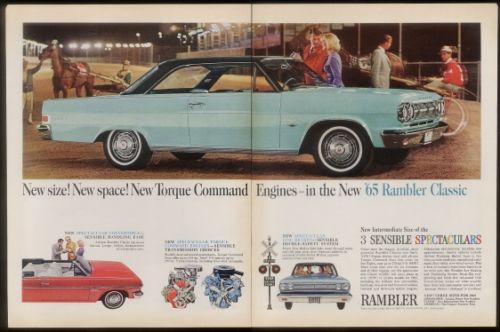
Here’s a two-page spread for the 1965 Rambler Classic (sorry it doesn’t enlarge much) set at a nighttime harness track.


Finally, this 1932 travel ad urges vacationers to head to Southern California for the Los Angeles County Fair and its harness racing. Cool.

Thursday, March 10, 2011

The Worst Marketed Sport in History

An interesting (not to mention apropos) interview with Mike Repole by Jay Privman in Thursday’s Daily Racing Form, including this astute observation by Repole:

I think racing is the worst marketed sport in the history of sports. If not for the passion of the fans, the sport wouldn’t exist. Racing has done almost everything wrong to the fan, and for some reason the fan sticks around. Any track can do whatever they want. There’s no governing body like NASCAR or the NFL, no one person to go to. It would take me a year to turn it around. You start with the fan. Everything else comes underneath. The fan who shows up with $20 in his pocket is just as, if not more, important than the gambler who shows up with $2,000. Racing doesn’t get that. It’s all about the handle. All the brands I’ve built are about education, awareness, and trial. This sport doesn’t educate owners or fans. Awareness? Ask people what they think about racing, and it’s a 77-year-old man smoking a cigar, or a blue blood from Kentucky. Is that perception or reality? You have to change that.

Talk about preaching to the choir! Amen, brother. Why isn’t there a concerted effort to organize start times nationwide, so fans and horseplayers don’t have to choose which race to watch or bet on? Why can’t we have one set menu of wagers with the same low take-out? Why don’t we develop and honor horses for a yearlong body of work, not just aim them for one big year-end race—and the easiest route to get there? Why can’t we establish more stringent rules regarding drug usage and other dangerous practices inflicted on the horse—and enforce them nationwide, with lifetime bans on trainers and owners when appropriate? Why don’t we consolidate racing dates and tracks to ensure full fields and the best quality product possible at every skill level of the sport?

Sorry, but he’s absolutely right. If all that the sport is concerned about are horseplayers and handle, then the sport will die. Gamblers can and will move on to other gaming opportunities, but without the fan—those whose love for the sport motivates them to wager, or perhaps even become owners themselves—horse racing can and will implode. Read carefully. That is not to say that horseplayers and handle aren’t important for the sport—obviously they are. However, they should not be the only focus of what pitiful marketing the individual tracks do, because their interest in the game is fickle. If a better opportunity for financial return comes along, their attention wanes. It’s the fan who, for better or worse, will stick around until the bitter end.

Wednesday, March 9, 2011

Out in Front

Derby contenders Uncle Mo and Stay Thirsty have owner Mike Repole sitting in the catbird seat these days and from all accounts it could not be happening to a nicer guy. In his relatively short time involved in the sport (he bought his first horse in 2002), Repole has done nothing but good things when it comes to promoting the sport, including casting Shaquille O’Neal as a jockey in this 2008 Super Bowl ad for Vitaminwater:


Unfortunately, we don’t see horse racing in mainstream advertising that much anymore, but (once again) that wasn’t always the case. As someone whose “real job” requires the study of visual images and interpreting their contextual meaning, these ads fascinate me. They reveal how profoundly ingrained in American culture thoroughbred racing once was.


Not surprisingly, hard liquor ads in particular often featured horseracing themes, like these two for PM whiskey, one from 1948 illustrating Citation’s walkover in the Pimlico Special (click to make larger), and the other from 1951 recalling the great 1938 Seabiscuit vs. War Admiral match race.

Notice the racing lingo bantered about so casually, as in this 1956 ad for Schweppes (“odds-on favorite”) and this 1959 Coke ad (“your money’s on the favorite...”). Even long-time horse owner and founding partner of Del Mar racetrack Bing Crosby lent his image to Royal Crown soda for this 1945 ad that also cross-promotes his latest film (“You bet RC tastes best!”).


Love this 1959 ad for the Plymouth Fury convertible! “Full of fury and eager to run! They’re off! And this sleek, sure-footed Plymouth Sport Fury steps ahead and stays ahead. With its New Golden Commando 395, biggest V-8 in the low-price field, it gives you instant response without the least bit of strain—all the horses you could want for modern driving…For this well-muscled beauty handles with sports-car ease, too.”


Here’s one from 1943 for Breeze aircraft engine starters: “Quick starting. Seconds saved in starting can bring victory.” Not surprisingly, if you read down through the ad it mentions they are used in military and naval aircraft, so the victory alluded to and symbolized by the race horse is more specifically referencing our efforts in World War II.

Alcohol, cigarettes, automobiles...one can readily get the connection to horse racing with those products, but how about this 1948 ad for Textron women’s blouses: “Pick two to win. Wonderful to show too.”

Monday, March 7, 2011

Creating a Super Horse

It’s official: Rachel Alexandra is in foal to Curlin. Considering her sire Medaglia d’Oro, I’m thinking Golden Curls or Golden Curlin—too bad Golden Child isn’t available. I do see according to the Jockey Club Registry that someone has reserved Curlin’s Alexandra—god, I hope that’s not the name they choose. Another route to go: Mydadlosttoagirl.

Breeding female Horse of the Year winners to male Horse of the Year winners isn’t a new occurrence, but it’s also not exactly proven to be terribly successful either. For example, Azeri (2002) produced an AP Indy (1992) colt named Take Control who won his one and only start, and an as-yet unraced Ghostzapper (2004) filly named Wine Princess. Lady’s Secret (1986) produced two Skip Away (1998) foals—Bear Witness and Secret Stranger—that between them, in 28 starts, hit the board only once, a maiden special weight win by Secret Stranger at age 5. Her three Seattle Slew (1977) progeny weren’t much better: in addition to the unraced filly Sleepinginseattle, there was the Japanese-raced filly Agnes Liner who won only once, while the gelding Vigor didn’t win in three attempts and was euthanized after a workout breakdown at age 4. Then again, Lady’s Secret didn’t produce much of anything as a broodmare. Neither did Regret (1915) whose two daughters by Johren (1918)—Nemesis and Stigma—both failed to win.

On the other hand, Moccasin (1965) was a decent producer, including the dual Golden Rod/Pocahontas winner Flippers. By Damascus (1967), she produced the unraced filly Sandal and Irish Group 3 winner Belted Earl who, at age 4, was champion older horse and sprinter in Ireland. By Round Table (1958), she produced three colts, all stakes winners, including Irish Group 3 Railway winner Brahms and English Group 1 winner Apalachee, the latter who was champion juvenile in England and Ireland in 1973 (not to mention a terrific sire).

Going back even farther, Twilight Tear (1944) produced stakeswinners Bardstown and A Gleam by non-Horse of the Year stallions, but her mating with Count Fleet (1943) produced an unraced (but stakes winner producing) mare Diamond Tear. Both of her Whirlaway (1941-42) colts—Foremost and Coiner—were winners, the latter a stakeswinner who finished in the money 47 times in 109 starts.

Sunday, March 6, 2011

A Parallel Universe?

Are we living in a parallel horse racing universe these days, one in which trainers actually see the Big Picture and don’t push their Kentucky Derby candidates to win early? Todd Pletcher holds juvenile champion Uncle Mo out of traditional prep races like the Grade 2 Tampa Bay Derby in favor of a specially-written race (the $100,000 Timely Writer) at Gulfstream over eight furlongs—one that the Toddster makes sure happens by nominating 12 other horses for it. Off his victory in the one-turn mile Grade 3 Holy Bull, Nick Zito enters Dialed In against older allowance horses going nine furlongs—and gets beat by his own stablemate. Bill Mott is “pleased” after previously-undefeated To Honor and Serve finishes third in the Grade 2 Fountain of Youth, having “needed the race.” Is it a brilliant strategy or just plain crazy? Obviously, that yet remains to be seen, but call me leery.

These unconventional paths to the first Saturday in May appear almost schizophrenic, but I wonder how much they are in reaction to the litany of injuries suffered by last year’s top contenders.

Meanwhile, there are those for which hope ever springs eternal, like Bob Baffert still thinking The Factor is anything but a sprinter; ditto for Rick Dutrow-trainee Flashpoint. However, tempering those with Derby fever are owners like those of Borderland Derby winner Fusa Code and apparently even Todd Pletcher-trained Cal Nation. Call me shocked when, immediately after her Grade 1 Santa Anita Oaks victory, Turbulent Descent’s trainer Mike Puype ruled out a Kentucky Oaks run, based on her distance limitations. Since when does the realistic outlook seemingly dominate trainers’ thinking? Truly amazing.

Every year I base my Derby contenders list on a mixture of performance and pedigree, so this year’s peculiar campaigns don’t make it easy. Thus, for better or worse, I’m leaning on pedigree and potential rather than actual accomplishments in my thinking. My top 10 list this week:

1. Stay Thirsty

Based on his decent performance in the Gotham and his pedigree, Stay Thirsty should have no problem getting the Derby distance. His half-brother Andromeda’s Hero ran a strong second behind a dominant Afleet Alex in the Belmont Stakes; his second dam Make Change (by stamina-rich sire Roberto) was Grade 1-placed multiple times going 9 to 12 furlongs. Next: Grade 1 Florida Derby, April 3.

2. Dialed In

Yes, he finished behind stablemate Equestrio in an allowance race on Sunday, but I’m looking at that effort as nothing more than a glorified workout. With a small five-horse field, there was no speed, and Julien Leparoux never asked Dialed In to run until he moved from the rear around the final turn. I was pleased that he easily got the 9 furlong distance, so I’m still on board the Dialed In bandwagon. Next: Grade 1 Florida Derby, April 3.

3. To Honor and Serve

Unlike others, I’m willing to give Bill Mott the benefit of doubt. His damside has plenty of 8.5 furlong winners—Afleet Deceit, India, and Rahy’s Attorney, not to mention his dam Pilfer. That little extra Bernardini influence may carry him even further. Next: Grade 1 Florida Derby, April 3.

4. Uncle Mo

I’m becoming less and less enchanted with Uncle Mo—regardless of witnessing his dominating Breeders’ Cup victory in person. As an Indian Charlie colt, the stamina question lingers for me and starting his 3-year-old campaign in a one-turn mile event doesn’t exactly inspire confidence that he’ll have enough backbone to go 10 furlongs. Next: non-graded Timely Writer, March 12.

5. Soldat

Turf or dirt, this War Front colt has got it done. His damsire Coronado’s Quest won the Grade 1 Travers, but there’s much to indicate some distance limitations on this one. Still, based on his current level of performance, he ranks high among contenders. Next: Grade 1 Florida Derby, April 3.

6. Brethren

For the very reasons I liked Super Saver last year, his little half-brother Brethren rates highly in terms of getting the Derby distance. Next: Grade 2 Tampa Bay Derby, March 12.

7. Rogue Romance

Last year’s third-place finisher in the Breeders’ Cup Juvenile began his 3-year-old campaign with a late-closing third in the Grade 2 Risen Star. His half-brother Tizbig finished strongly running second to Mint Lane in the 2008 Grade 2 Dwyer, a race won in 1986 by their second dam’s half-brother Ogygian. This is also the family of Grade 1 Met Mile victor Honour and Glory. He’s got the right running style, not to mention having already run well at Churchill Downs. Next: Grade 2 Louisiana Derby, March 26.

8. Wilkinson

Not many have this Lemon Drop Kid colt in their top 10, but I liked his gutsy finish in the Grade 3 Lecomte. Yes, I do think his win there was almost solely based on jockey Garrett Gomez’s ability to “carry” a horse over the wire, but his pedigree features a second dam by the great turf router Manila. I also respect trainer Neil Howard tremendously. Next: Grade 2 Louisiana Derby, March 26.

9. Sway Away

Yes, he’s not yet raced beyond 7 furlongs or won a graded event, but the way he closed in the Grade 2 San Vicente against speedy The Factor makes me believe this is perhaps the best California-based contender. What a tremendous stamina pedigree, by Afleet Alex out of a Seattle Slew mare, and his second dam by Summer Squall. Still, without actually trying route races, it’s hard to move him up farther. Having Garrett Gomez stay aboard for the Rebel is a promising sign, though. Next: Grade 2 Rebel, March 19.

10. What The Toccet

I’m bored with the typical contenders, so here’s my wild card—a Sunland Park-based maiden trained by Shannon Ritter. He’s bred to run all day, by Toccet out of a Coronado’s Quest mare who is a half-sister to Grade 1 Donn winner Spring at Last, Grade 1 Las Virgenes victress Sharp Lisa (who won going 10 furlongs) and Grade 1-placed router Sharp Susan. This is also the family of multiple Grade 1 router Bien Bien (who even won at 14 furlongs)—if he wins the Grade 3 Sunland Derby, a serious Derby contender. Next: Grade 3 Sunland Derby, March 27.

Evolution of a Blogger

Four years ago to the day I began this blog after returning as a fan (and new bettor) to the sport that captivated my youth. As I mentioned in my initial posting back in 2007, it was one horse—Foolish Pleasure—who first captured my heart, and drew me as a youngster to horse racing, even though we lived nowhere near a racetrack. The 1970s were, arguably, the last “Golden Age” of the sport, with the likes of Secretariat, Seattle Slew, Affirmed and Alydar, Forego and Spectacular Bid, to name but a few. For a variety of reasons, not the least of which was the inaccessibility of horse racing to me then living in the backwoods of Pennsylvania, first in Slippery Rock and then State College, my interest waned only to be briefly revived each year with the stirrings of spring and the arrival of the first Saturday in May.

Four years ago, I discovered off-track betting, thanks to my now-retired division chairperson who, as a displaced New Yorker, mightily missed the confines of Belmont Park. For the very first time, I learned about wagering and handicapping, initiating an entirely new outlook for me on the sport. It was also the year when advance deposit wagering (ADW) fortuitously emerged, opening up virtually the entire world of horse racing to me from the comfort of home. I fell in love with Australian racing and thus found myself often exploring its joys through my writings. In hindsight, I understand my blog writing experience has mirrored the technology-driven changes in the sport, recording both positive and negative aspects of this on-going revolution—including the advent of Twitter and Facebook.

As a blogger, I evolved from merely a dilettante handicapper and ill-informed blowhard, to one more confident and educated in her opinion, thanks in no small part to fellow bloggers whose passion for and knowledge of the sport raised the bar for me, both in terms of my approach to writing about a topic, as well as the quality of my writing. This pioneering group—many still members of the Thoroughbred Bloggers Alliance while others have since retired from blogging or set out on their own—welcomed me to the blogosphere, and for that encouragement, I am eternally grateful. They include: Patrick Patten (Handride); Alan Mann (Left at the Gate); Lisa Grimm (Superfecta); Jessica Chapel (Railbird); Jennifer Morrison (Jen’s ThoroughBlog); Sue Broux (Post Parade); Tracy the Quinella Queen (Turf Luck); and the incomparable (albeit somewhat twisted) John (The Race is Not Always to the Swift).

So many others who followed continue to inspire me as well, including Teresa Genaro (Brooklyn Backstretch), Kevin Martin (Colin’s Ghost), Dana Byerly (Green But Game), Sid Fernando (Sid Fernando + Observations), Gene Kershner (Equispace), and Ted Grevelis (Owning Racehorses), just to mention a few. There's also a whole host of talented "youngsters" on the current TBA blogroll I encourage you to check out. Of special note are those international bloggers who have taught me so much about racing in the Philippines (Jenny Ortuoste at Go Girl Racing), Korea (Gyongmaman at Horse Racing in Korea), and Japan (Kate Hunter, Keiblog). Also, Keith McCalmont (Triple Dead Heat) covers Canadian racing with tremendous style and knowledge, as does trainer (and ex-pat) Gina Rarick in France (Gallop France). Surprising, a blogger has yet to emerge from Australia or New Zealand, or even England, but perhaps it’s only a matter of time as the horse racing world continues to shrink, and globalization continues.

In honor of my four-year anniversary and nearly 100,000 visitors (a truly humbling mark I should pass in the next few weeks), here is a chronological compilation of some of my favorite posts, even a few from those early years (and some with hysterical titles). Moving forward, I hope I’ll still have the same fire to write about horse racing four years from now—presuming the sport is still around to enjoy. Thanks for reading!

“Why I’m Not Feeling the Love in Love Dubai” April 12, 2007.
“A Day at the Races” August 12, 2007.
“Bill Hartack: Salt of the Earth” December 1, 2007.
“Horse Racing 101” March 16, 2008.
“Eight Belles, I Plead for Thee” April 27, 2008.
“A Lesson in History” May 8, 2008.
“Drug Poster Boys” June 28, 2008.
“A Big Brown Stain on the Underpants of Racing” June 9, 2008.
“Vote ‘No’ for Schrupp as Czar” July 10, 2008.
“2009 Hall of Fame Nomination” (Xtra Heat) August 5, 2008.
“Revelations in Death: Genuine Risk” August 24, 2008.
"Rethinking the Breeders' Cup" October 11, 2008.
"The Death Knell of Dirt Racing?" October 26, 2008.
"Do Harness Racing Folks Have Libido Overdrive?" December 7, 2008.
"The Year That Was" December 31, 2008.
“The Legendary Football Team That Horse Racing Built” January 19, 2009.
“Sallie Gardner: The Horse Behind the Photograph” March 2, 2009.
"Fearless" March 26, 2009.
"Fanning the Flames" April 9, 2009.
"Giving the Bird (a Chance)" April 23, 2009.
"The Best Possible Result for Racing" May 18, 2009.
"Why Pretend it Didn't Happen?" June 20, 2009.
"Tiny Stars Shine Just as Brightly" August 24, 2009.
“On Perspective and Bias” November 22, 2009.
"Let's Pretend It Really Happens" February 5, 2010.
"A Lament for Horse Racing in Pennsylvania" May 6, 2010.
"The Tragic Mystery of Sunny Man" May 11, 2010.
"What’s In a Name?—or Beauty Is in the Eye of the Beholder" July 14, 2010.
"Just How Dumb Do They Think We Are?" September 2, 2010.
"Glass Half-Full, Not Half-Empty" September 13, 2010.
“If ‘Secretariat’ Can’t Save Us” October 12, 2010.
“Yet Another Lament” November 28, 2010.
"Curiosities of Winter and Night Racing" January 15, 2010.

Friday, March 4, 2011

Jockey Shorts

Just ask Eibar Coa and Paco Lopez, or Brandon Meier. Being a jockey is a dangerous, thankless job, and over the past 30 days a notable number of incidents at Gulfstream, Santa Anita, Penn National and Aqueduct have rammed home that point. Yet, beyond the charismatic good ol' boy Calvin Borel and superstar Zenyatta’s long-time partner Mike Smith, most jockeys remain nearly anonymous to the general public these days. It wasn’t always that way.

During racing’s “Golden Age” jockeys enjoyed tremendous fame and status in American society, a natural occurrence given the sport’s high-profile and popularity. Eddie Arcaro and Bill Hartack both appeared on the cover of Time magazine at the height of their careers, while numerous Sports Illustrated covers featured jockeys such as Willie Shoemaker and Stevie Cauthen, Johnny Sellers and Johnny Longden.


Even that most quintessential of American weeklies, The Saturday Evening Post, published at least two jockey-themed covers.

In 1977, art collector and sports enthusiast Richard Weisman commissioned Andy Warhol to create—for a mere $800,000—a series of silk-screen paintings featuring 10 iconic athletes of the era. Each athlete chosen was paid $15,000 to allow Warhol to take Polaroids of them which would be silk-screened in various colors, with a total of six versions produced for each image. One set of the finished works, the one Weisman displayed in his West Los Angeles home, was stolen in 2009, although oddly Weisman refused to collect on the $25 million insurance policy just a month after the heist. However, other versions of the works live on in public collections and in authorized prints.

For those of us who grew up in the 1970s, who didn’t know figure skating champion Dorothy Hamill and tennis star Chris Evert, baseball pitcher Tom Seaver and soccer superstar Pele, basketball’s Kareem Abdul Jabbar and football running back OJ Simpson, golfer Jack Nicklaus and boxer Muhammad Ali? New York Rangers winger Rod Gilbert would soon be overshadowed by the phenomenon that was Wayne Gretzky, but The Shoe, Willie Shoemaker, would go on to win an Eclipse Award in 1981, not to mention his fourth Kentucky Derby (with Ferdinand in 1986, at age 54).


In his diary entry for March 28, Warhol discusses not only the scope of the commission, but also the conditions under which he took Shoemaker’s photograph:

At 4:00 I went to Fred’s room to photograph Willie Shoemaker the jockey. Richard Weisman’s commissioned me to do a series of athletes’ portraits. Richard will keep some of the portraits and some will be for sale and the athletes will get to keep some. So Willie was the first athlete…Willie’s wife called from the lobby and she came up with a girlfriend—but without Willie. He didn’t show up till ten after 5:00 and when he saw her, he couldn’t believe she was there. He’d been court getting a divorce from her, that’s why he was late.

Willie’s ex-wife of one hour was one of the tallest women I’ve ever seen. She was dressing Willie for the picture and he looked like an eight-year-old kid. And guess what he was wearing—little Jockey shorts! Ordered martinis, and the wife was drinking. She kept asking him for a date to celebrate the divorce and he kept turning her down, he said, “If I’d known you were going to be here I wouldn’t have come."

Ironic, isn’t it, that the ultimate celebrity whore Andy Warhol ended up immortalizing the shy Shoemaker, a man who—as Bill Nack noted in his 1980 Sports Illustrated article—despised the Beverly Hills/Hollywood social scene which so dominated his life during his marriage to Babs Beyer. And how prophetic that Warhol remarked upon completion of the Weisman series, “The sport stars of today are the movie stars of yesterday.”

So true today of most sports stars, that is, except those in the dying sport of horse racing.